
Brow Lift
Surgical elevation of a descended brow — endoscopic, direct, and coronal techniques to restore brow position and reduce forehead lines.
What is a Brow Lift
A brow lift (forehead lift) is a surgical procedure to elevate a descended brow to its natural resting position above the orbital rim. As the forehead and brow tissues descend with age, the brows may fall below the supraorbital rim, imparting a tired, heavy, or angry appearance. Brow ptosis can also mimic or worsen upper eyelid skin excess, and it is essential to evaluate brow position before performing upper blepharoplasty.
The brow and upper eyelid are closely related — see Blepharoplasty for details on combined upper eyelid surgery, and Anatomy Overview for the relevant anatomical structures.
Anatomy of the Brow
The brow complex consists of skin, subcutaneous fat, the frontalis muscle, the galea aponeurotica, and the periosteum of the frontal bone. The frontalis is the only elevator of the brow; the corrugator, procerus, and depressor supercilii are antagonist depressors.
- Normal brow position (female): The brow begins medially at or just above the supraorbital rim, arches upward, and peaks at the lateral limbus or lateral canthus. The lateral brow sits higher than the medial brow.
- Normal brow position (male): Flatter, at or just at the supraorbital rim, with less lateral arch.
- Sensory supply: Supraorbital and supratrochlear nerves exit foramina along the superior orbital rim and supply the forehead and scalp. These must be protected in all brow lift techniques.
- Motor supply: The frontal branch of the facial nerve (VII) courses within the temporoparietal fascia just below the temporal hairline and is the critical structure at risk in temporal approaches.
Coronal Brow Lift
The coronal brow lift uses an incision placed from ear to ear across the top of the scalp, 5–6 cm behind the hairline. It provides the most powerful and predictable elevation of the entire brow and forehead, and allows direct access to the corrugator and procerus muscles to reduce glabellar frown lines.
Procedure at a Glance
- Incision hidden within the hair-bearing scalp
- Provides 1–2 cm of brow elevation
- Elevates the entire forehead symmetrically
- Not suitable for patients with high hairlines or male pattern baldness
- Risk: temporary or permanent scalp numbness posterior to incision
Endoscopic Brow Lift
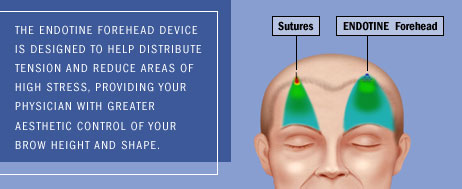
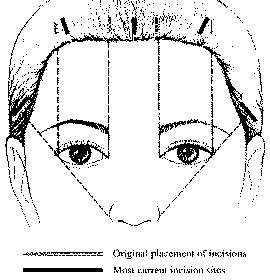
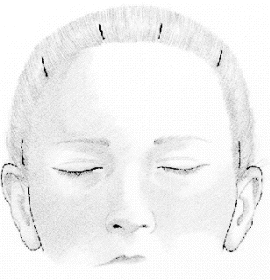
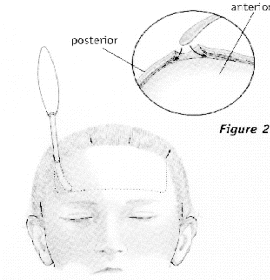
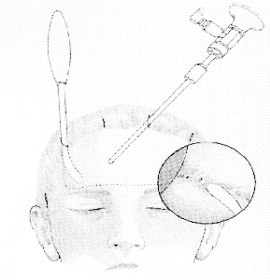
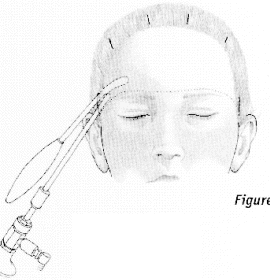
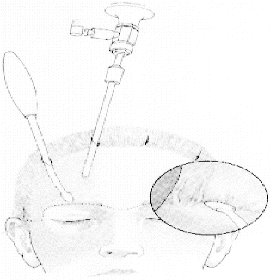
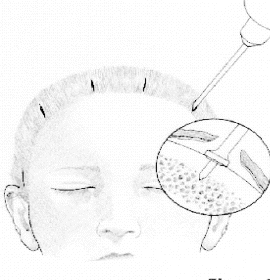
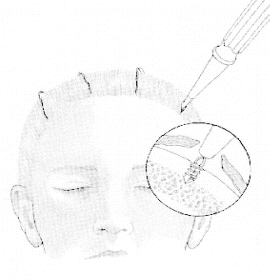
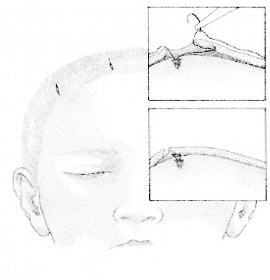
The endoscopic brow lift has largely replaced the coronal approach for patients with a normal hairline. Three to five small incisions (1–1.5 cm) are placed within the scalp behind the hairline. A rigid endoscope is inserted to visualize the sub-periosteal plane, and the brow is elevated and fixed using absorbable or permanent fixation devices (screws, Endotine implants, or suture tunnels).
- Advantages: Minimal scarring, shorter recovery, less risk of scalp numbness than coronal approach.
- Limitations: Less powerful elevation than coronal; does not allow direct muscle removal for frown lines; requires specialized equipment and training.
- Animation: An interactive animation demonstrating the endoscopic brow lift technique is available for educational viewing.
Endoscopic Technique — Step by Step
Direct Brow Lift
The direct brow lift places the incision directly above the superior eyebrow hairs. It provides precise, powerful elevation of the brow and is particularly effective for patients with significant unilateral brow ptosis or facial nerve palsy where one brow has descended dramatically.
- Advantages: Simple technique, powerful elevation, suitable when hairline anatomy precludes other approaches.
- Disadvantage: The scar above the brow is visible, particularly in men with thin or absent eyebrow hair. Careful closure minimizes visibility over time.
- Best candidates: Patients with facial nerve palsy causing unilateral brow droop, or patients who prefer targeted lateral brow elevation with a short scar.
Indirect (Mid-Forehead) Brow Lift
The indirect brow lift places the incision within a prominent forehead skin crease, one to several centimeters above the brow. It is most appropriate for male patients with deep forehead rhytids where the scar can be camouflaged within an existing crease.
- Provides moderate brow elevation without entering the scalp
- Scar hidden in a forehead crease — best in patients with prominent horizontal furrows
- Not suitable for patients with smooth foreheads where the scar would be visible
Combination with Eyelid Surgery
Brow and eyelid surgery are frequently performed together to restore the natural relationship between the brow, upper eyelid platform, and lower eyelid. The sequence matters:
- Brow position must be assessed and corrected before upper blepharoplasty. Performing blepharoplasty on a patient with unrecognized brow ptosis risks removing too much upper lid skin and worsening brow descent further.
- Combined brow lift and upper blepharoplasty in the same operative session allows precise intraoperative assessment of the upper lid platform after brow elevation, ensuring the correct amount of skin is resected from the eyelid.
- Lower blepharoplasty and midface procedures may also be combined with brow lift for comprehensive periorbital rejuvenation.
Recovery
- Swelling and bruising primarily over the forehead and around the eyes — expected for 7–14 days
- Head elevation reduces swelling; ice packs during the first 48 hours
- Endoscopic: most patients return to social activities in 10–14 days
- Coronal: slightly longer recovery due to larger incision; numbness behind the incision may persist for weeks to months
- Direct brow lift: fastest recovery; sutures removed at 7 days
- Final result stable at 3–6 months; results typically durable for 5–10 years
The best brow lift technique depends on your anatomy, hairline, degree of ptosis, and goals. An oculoplastic surgeon can evaluate which approach is most appropriate for you.
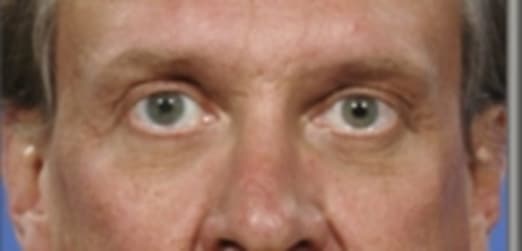
Brow Lift Before & After
1 / 3Drag the divider left or right to compare. Select a case in the strip below.

Frequently Asked Questions
- What is a brow lift?
- A brow lift (forehead lift) is a surgical procedure that elevates a descended eyebrow to a more youthful position. It also reduces forehead wrinkles and furrow lines between the brows. It is frequently combined with upper eyelid blepharoplasty.
- What is the difference between a brow lift and blepharoplasty?
- A brow lift raises the brow itself; blepharoplasty removes excess eyelid skin. Many patients have both brow descent and excess upper eyelid skin — if the brow is not lifted first, blepharoplasty alone may result in an unnatural appearance or unsatisfactory outcome. An oculoplastic surgeon can determine the correct procedure.
- What are the types of brow lift?
- The main techniques are: endoscopic brow lift (small incisions behind the hairline, camera-assisted); coronal brow lift (longer incision across the scalp, the most powerful elevation); direct brow lift (incision just above the brow — highest precision, best for men or patients with deep brow furrows); and indirect brow lift (incision in a forehead wrinkle).
- Is brow lift recovery painful?
- Most patients describe moderate tightness and numbness rather than severe pain. Swelling and bruising peak at 48–72 hours and resolve in 2–3 weeks. Most patients return to social activities within 10–14 days.
- Am I a good candidate for a brow lift?
- Good candidates for brow lift surgery typically have a descended or drooping brow that affects their appearance or vision, are in overall good health, have realistic expectations about results, and do not smoke or are willing to quit before and after surgery. During a consultation with a fellowship-trained oculoplastic surgeon, your brow position, skin elasticity, forehead lines, and medical history will be evaluated to determine if you're an ideal candidate. Age alone is not a limiting factor—what matters most is your goals and ability to follow post-operative care instructions.
- What should I expect during a brow lift consultation?
- During your consultation, your oculoplastic surgeon will examine your brow position, assess your facial anatomy, discuss your aesthetic goals, and review your medical history to ensure you're a safe surgical candidate. The surgeon may take photographs and use imaging to show you potential results and explain which brow lift technique—endoscopic, direct, or coronal—is best suited for your needs. You'll also receive detailed information about recovery timeline, potential risks, and post-operative care so you can make an informed decision.
- How long do the results of a brow lift last?
- Brow lift results are long-lasting, with most patients enjoying improved brow position and reduced forehead lines for 10 years or longer. Over time, natural aging and gravity will gradually affect the brow's position, but the improvement achieved during surgery is typically permanent compared to your pre-operative appearance. Some patients choose to undergo revision surgery years later if they desire further enhancement, though this is not necessary for most people to maintain satisfaction with their initial results.
Find a Specialist
Connect with a board-certified oculoplastic surgeon who specializes in brow lift.
Search the Directory →